🪓The Swiss Army Knife of the Stone Age 🧰 Acheulean Hand Axe ✋🪨
👣 A follow-up story that connects to the Early Human Beings chapter in the History Album, branching directly from the Hand Timeline. ✋🧠 This story highlights the power of human tendencies: repetition, communication, imagination, and cooperation — as early humans observed stones, tested techniques, passed knowledge without words, and shaped the future. 🪨✨🧰🔁 The hand axe becomes a symbol of both survival and creativity — helping early humans cut, scrape, dig, and shape their environment. It prepares the child for further discoveries in the First Timeline of Humans, fundamental needs, and how tools reflect the birth of human culture. 🌍🪵🔥 This story sparks the question: What can your hands do? What would you make, if all you had was stone? ✨💭
HISTORY STORIES
1/17/20264 min read
👣 Do you remember the story about the first humans?
The story that told us how, after billions of years of life on Earth 🌍, something new appeared — a being with a hand that could work ✋, a mind that could think 🧠, and a heart that could love ❤️?
Humans didn’t arrive with big teeth 🦷 or sharp claws 🐅 or the ability to run faster than any animal 🐆. But they came with something far more powerful: The tendency to explore 🧭, the desire to create 🎨, the drive to survive 🔥, and the power to cooperate 🤝.
They looked at their surroundings, not with fear, but with curiosity 👀. And they wondered: How can we keep our bodies warm? How can we dig deeper holes? How can we catch that big, heavy predator with sharp teeth and big claws? What can help us survive?
The early humans looked at their own bodies. They had hands — strong, flexible, and clever. ✋💪And they had something else: a brain full of ideas, brain that could observe, and love experiments 🧠🔍. They watched where animals went. They tried making traps.They failed. They tried again and they sucseeded. They tried making tools,failed, and tried once more 🔁.
Then something amazing happened. They looked around and didn't see just stones anymore , they saw tools! And soon… they began to make tools from stones 🪨.
And so, during the Palaeolithic period, a fancy name coming from two Greek words: palaios, meaning "old"; and lithos, meaning "stone" also known as "old age of the stone" or " Old Stone Age. A time between about 1.7 million and 200,000 years ago, when humans began shaping one of the most important tools in history 🪨.
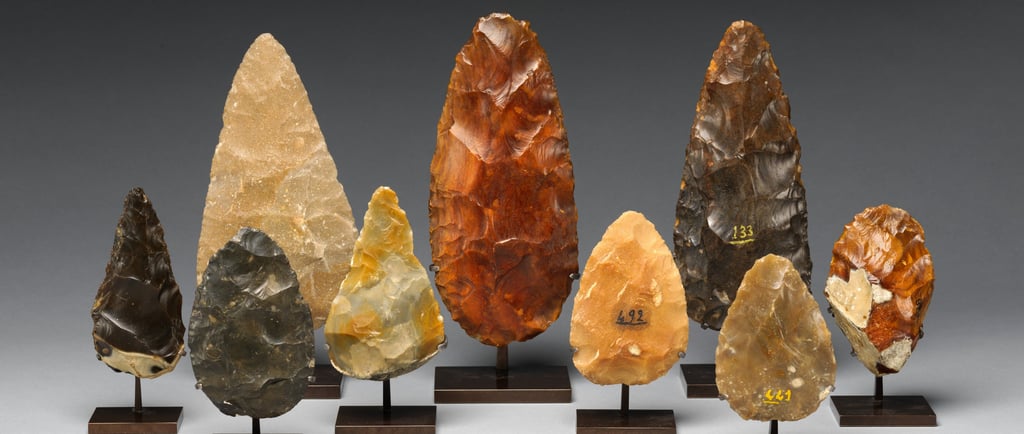
You may remember the Timeline of the Hand ✋⏳, where we saw in the middle of the timeline that image — a hand holding an axe 🪓. That wasn’t just any axe. That was the Acheulean hand axe, a tool so well designed that it was used for over a million years ⏰🌍. Let’s clap the name together : 👏A-cheu-le-an. 👏 Another fancy name that comes from a place in France called Saint-Acheul, where some of the first hand axes were found. 🪨
Some Acheulean hand axes are as big as a dinner plate and weigh more than 5 kilograms — that’s like carrying a backpack full of books, far too heavy to use! Scientists think these may have been practice pieces, show pieces, or even early symbols of skill. Showing the mastery of shaping stones.
But the tool itself was invented in Africa — the very cradle of humanity. And lasted longer than any tool humans have ever made since. 🤔 Do you think the tools we invent today will still exist thousands of years from now?
But how did they do this special hand axe?Early humans didn’t just pick up any rock and start chopping. They observed 👁️.They experimented 🧪.They discovered that some stones broke in useful ways — making sharp, strong edges ⚡.These stones were rich in silica— a mineral that makes rock hard and glassy, perfect for sharp edges. Some of the best stones for tool-making were flint, chert, quartzite, and basalt 🪨🔬.
They learned which stones to choose ✅.Then they developed techniques 🧠🛠️.They would strike one rock against another — this technique is called knapping. From the old Germanic word knoppan, meaning “to strike or chip” 💥
With hard percussion, they used a hammer stone, just a rounded rock 🪨 to break off large flakes. Later, they used soft percussion, tapping with antler or bone 🦌💀 to shape the edges more precisely.
Imagine the first humans, sitting by the fire 🔥, holding a rock, and slowly shaping a life saving tool that will last milions of years ? 💎 Some hand axes are so symmetrical that researchers believe humans cared about beauty, not just survival. Each one was unique, handmade, shaped over hours with patience and care.
The Acheulean hand axe was like the Swiss Army knife for early humans.🪓🧰. But had no handle, is shape fit perfectly into the palm, with sharp edges all around. And it worked. ✋✅ ✋🪨 It could cut meat 🥩, slice plants 🌿, dig for roots 🌱, scrape skins, and chop wood 🪵. I
But they didn’t make just one. They made them again and again, teaching others 👥, passing on the knowledge 🗣️. That’s the tendency to repeat and perfect ♻️. And they did all of this without words, just hands, eyes, and shared experience.
They cooperated 🤝. Perhaps someone was searching just one particular type of stone. Children and adults were watching whoever was the master of knapping. 👁️.They imitated and they remembered 🧠. This was the beginning of something much bigger than a tool. It was the beginning of the passing on of knowledge and skills with purpose🌟.
And even today, when scientists who study the lives of early humans called archaeologists, find a hand axe buried deep in the Earth, they don’t just see a rock. They see a the tools shaped by human hands. A tool that helped our ancestors make clothes, prepare food, create new tools, and even make early forms of art 🎨.
Acheulean hand axes have been found all over the world.🌍. This wasn’t just a local invention. It was a tool that followed humans wherever they went.
I wonder… How did early humans share their knowledge without words? Now it is your time to go out and find a stone and try to shape it with your own hands? 🪨✋ What kind of rock would you choose? How can you recognize flint, chert, quartzite, and basalt? Are there other tools from the Stone Age that lasted as long?
Maybe, like the early humans, you’ll discover that the world around you is full of tools . 👁️🔍🛠️
Possible Follow-Up Explorations 🪨✋
🛠️Make Your Own “Hand Axe”
Try safe knapping techniques (with safety goggles and adult guidance) using chalk, soap, or soft clay.
🔬Stone Identification and Tool Testing
Gather different rocks and try basic experiments:
Which ones break easily?
Which ones have sharp edges?
Which ones are too soft?
Sort stones by texture, color, hardness, or silica content.
Classify stones by hardness, texture, or silica content.
🗺️Research and Map Work
Where have Acheulean tools been found? Make a Geography world map of their discovery sites.
With Montessori joy,
Vanina 😊