👑The Golden Age of Africa 🐫 Timbuktu and the Gifts of Mansa Musa 📖🎓
🌍 A follow-up story that connects Chapter: Cultures and Civilizations in the History Album with Human Geography and Migrations in the Geography Album. 🐫📚 It invites children to journey across the golden sands of West Africa to the legendary city of Timbuktu, where books were more precious than gold, knowledge flowed like the Niger River, and griots strummed the memories of empires under star-filled skies ✨🎶. Through the lives of scholars, storytellers, and kings like Mansa Musa, children explore how civilizations meet their fundamental needs in unique ways—through trade, faith, education, architecture, and cultural exchange. This story acts as a golden thread between oral traditions, sacred journeys, centers of learning, and the movement of people across time and place. It sparks wonder: “What happens to a civilization when its great leader is gone?” 👑🕊️🗺️
HISTORY STORIES
1/4/20266 min read
You remember when our ancestors first walked on Earth…🌱Which continent did they explore first? Yes—Africa.
The world around them was very different from the world we live in now. Herds of wild animals moved across endless savannahs 🐘🦒, trees towered high above them, and fire had not yet been tamed. The land around them felt scary and mysterious, inviting them to explore.
And yet, those early people already carried the same three great gifts that you carry today. They had a mind that could think and imagine 🧠, a hand that could shape and build ✋, and a heart that could love unconditionally ❤️. With these gifts, they learned how to survive, how to adapt, and how to create. Slowly, they made tools, clothing, stories, shelter, music, and art.
You may remember the First Timeline of Human Beings, where we saw how people met their fundamental needs—for food, for protection, for beauty, and for belonging. Over time, humans did not only survive; they learned how to live together and build communities.
We have also heard about the mighty Nile River, whose waters dance through deserts 💧, carve paths through stone🏜️, flood fields with life🌾, cradle boats like a mother’s arms 🚣, and carry stories along its currents. Beside this river, great civilizations such as Ancient Egypt grew and flourished. They built pyramids and temples, invented writing, created calendars, and studied the stars ✨.
🌞 But there were other civilizations in Africa that came after… and when they flourished, this long and brilliant time became known as the Golden Age of Africa.
During these golden centuries, 700 to 1000 years ago, the deserts of West Africa were far from empty. They were filled with life, movement, trade, and tales carried by the wind 🌬️🐪. It was one of the richest sources of gold in the world, and the shining trade of salt and gold made entire kingdoms rise and thrive.
Out of the golden lands of the Mali Empire, long caravans of camels crossed the Sahara 🐫, their footsteps quiet on the sand. The lands of the Mali Empire were filled with gold. Gold glittered in riverbeds and lay deep within hills and valleys. Trade routes crisscrossed the desert, and salt, cloth, and horses came from the north in exchange for gold. These caravans carried salt that sparkled like crystals 🧂 and gold that shone warmly in the sun 💛. But they also carried something even more precious than treasure—books 📖.
These camels were traveling toward a remarkable city called Timbuktu, a place that rose from the edge of the desert like a mirage. 🌵🏙️Timbuktu grew where the Niger River met the Sahara Desert, making it a perfect meeting place for traders from the north and the south. People from many lands passed through its gates, bringing goods, different languages, ideas and inventions from far away.
In Timbuktu, the marketplace sang with voices from many cultures 🌍. Traders exchanged ivory, cloth, spices, and copper, and the air buzzed with conversation and laughter. Imagine what challenges they had, to trade with someone who spoke another language!
🕌 Just beyond the market stood something even more special—the Sankore Mosque and University .
There are stories of merchants who arrived with silk or spices and left instead with books, saying,“Wherever I go, this book will be worth more than gold.”
People whispered: “In Timbuktu, gold may weigh heavy in your hand, but knowledge makes a person truly rich.”📚✨
Inside the mosque and university, scholars studied the stars 🌠, the Earth 🌍, the human body🫀, the laws of justice⚖️, and the wisdom of centuries past. They talked late into the night about medicine, philosophy, and astronomy under the soft glow of lanterns made from desert clay 🕯️. Some scholars wrote about the movements of planets and created star charts to guide travelers across land and sea. Others described surgical tools and explained how to treat wounds or deliver babies with great care. They even built instruments to measure time ⏳, diagnose illness, and observe the sky with astonishing accuracy.
And it wasn’t only grown-ups who studied in Timbuktu. 👦👧 Children like you studied there too. By the age of eleven or twelve, you might be memorizing poetry📝, write in beautiful Arabic calligraphy ✍️ , studying mathematics 🔢 , learning about the human body, and practicing how to argue with respect and logically. 🧠💬
Many children began learning at home and later studied with a teacher at a madrasa, a school often connected to a mosque. A school day often began in the cool morning air with quiet reading and writing 🌤️, followed by recitation, discussion, and copying texts by hand using bamboo pens dipped in natural ink made from charcoal or plant sap.🌿 Children wrote on wooden tablets called lawḥ, meaning "sheet of wood". Once they memorized their lesson, they would gently wash the ink away with water—clearing the surface to begin again.💧✍️
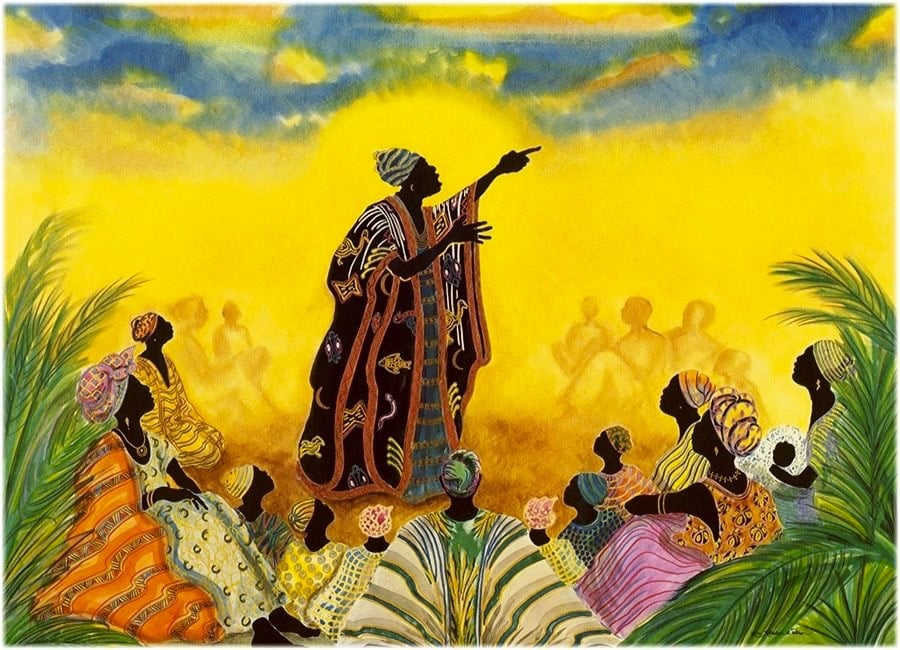
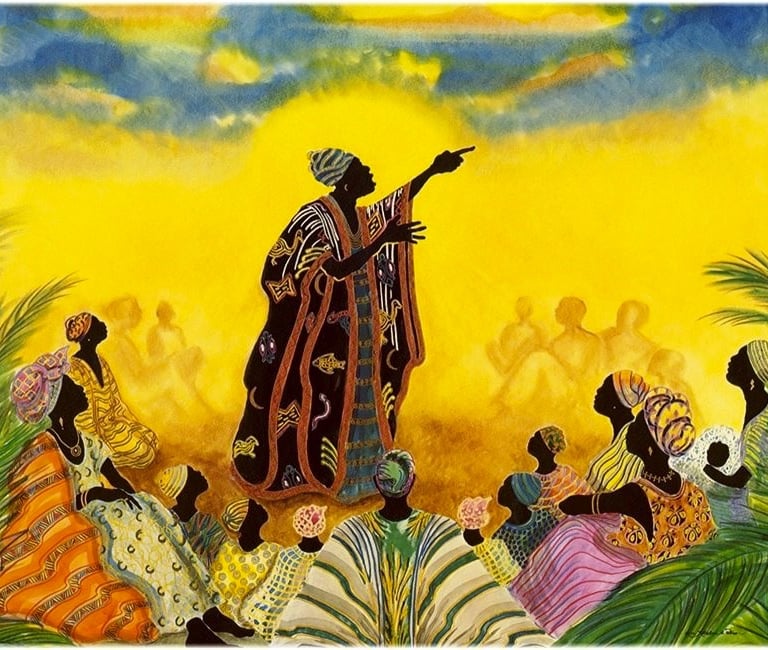
In the evenings, after lessons were done, the streets of Timbuktu echoed with music and stories 🎶🌙✨.Griots,🗣️( gree-oh ) the great storytellers of West Africa, gathered under the stars to share their tales. A griot was more than just a storyteller—they were also musicians, historians, and keepers of memory. They remembered the past of their people and passed it on through song 🎤, rhythm 🪘, and voice 💬, just like a living library. 📚
And sometimes, they told legends.
"There once was a boy named Sundiata. He was a prince—the son of a king—but he was born unable to walk. The other children ran through the village, but Sundiata sat quietly, listening to the sounds of the earth 🌍🌾. Some people laughed at him. Others said he would never be king.
But his mother whispered, ‘You have lion’s blood in your heart. One day, you will rise.’ 🦁
And one day, he did. He stood up, walked—then ran—and became the first great king of Mali.
They called him the Lion King of Mali, and his story still lives in the voices of the griots.” 🦁👑
Some say Timbuktu once held more than 100,000 books, carefully copied by hand and passed from family to family like treasure. These were truly golden days, when knowledge was valued as deeply as gold itself ✨📚.
👑 And then came the king whose name still echoes across Africa! 👑 Not a legend but a true King! His name was Mansa Musa —the ruler of the Mali Empire! Mansa means “king” or “emperor” in the Mandé language. He ruled over millions of people—farmers, traders, artists, teachers, warriors, and scholars—who spoke many languages and followed many traditions. Instead of forcing everyone to be the same, Mansa Musa respected these differences and wove them together into the strength of his empire 🤝.
His wealth came from the land—gold hidden in riverbeds, salt from the desert, and trade that flowed through Timbuktu and other great cities 💰🏜️. Yet Mansa Musa believed that wealth alone did not make a kingdom great. He believed that learning, faith, and justice were important just as much.
Before Mansa Musa ruled, another king had launched a voyage west across the Atlantic with a fleet of ships—he never returned 🌊🚢. So the crown passed to Mansa Musa, who made a different journey—one of faith, knowledge, and connection.
He chose to make a sacred journey through the desert, traveling to the holiest city of Islam— Mecca 🕋. The sacret journey is a journey of faith and reflection. He left with a caravan so grand that the world would never forget it: tens of thousands of people, camels loaded with gold bars, musicians playing as they walked, advisors, and scholars beside him. Scribes wrote about everything they saw. ✍️🎵🐫
🐫As he traveled through towns and cities, Mansa Musa gave gold to the poor, helped people in need, and built mosques and schools. His generosity amazed everyone he met. People began to ask, “Who is this king from the heart of Africa who travels with gold, kindness, and curiosity?” His journey was so famous that mapmakers drew him on world maps, sitting in West Africa with a golden crown and a nugget of gold in his hand 🌍👑.
When he returned home, in Timbuktu ,he brought books, teachers, architects, and ideas.🏛️He built schools, libraries, and mosques, and under his rule, Timbuktu became one of the most respected centers of learning in the world.
I wonder... 🌟 What happened to Timbuktu after Mansa Musa’s time? What came after the Mali Empire? What happened to all that gold and all those books? Are there still griots and koras today?
🔍 Possible Follow-up Explorations
🗺️ Create a map of the ancient trade routes of salt and gold across the Sahara.Where did the caravans travel from and to? Which cities were part of this golden network?
📖 Research other African legends. What stories have been passed down through generations by griots?
🏛️ Discover the empire that came after Mali. What was the next Empire, and how did it grow? What cities became famous for learning and trade after Timbuktu?
💰 Investigate today’s richest sources of gold. Which countries produce the most gold now? How is gold used today—and how does that compare to how it was used in the Mali Empire?
🧱 Explore ancient African architecture. What materials did people use to build homes, mosques, and libraries in Timbuktu and other desert cities? Can you build a model using clay, sand, or paper?
🌍 Learn about modern Mali. What languages are spoken there today? What traditional foods are cooked? What instruments are played? What do people wear for celebration and everyday life?
With Montessori joy,
Vanina 😊