The Dinosaur in My Backyard 🦖The Hen 🐔
🐔🦖 A follow-up story that connects Chapter Zoology of the Biology Album with early farming and civilization in the History Album. ✨ It invites children to meet the hen as more than a familiar farm bird: a feathered vertebrate with a beak, scratching feet, eggs, instincts, and ancient relatives, opening the way to adaptation work, and body systems, where the cleverness of nature can be seen in every outer part and hidden structure. 🌾🥚 At the same time, the hen quietly stretches into history, because she leads children to wonder when human beings first began keeping animals near their homes, what new knowledge was needed for village life, and how domestication helped shape farming, settlement, and eventually early civilizations. 🏡⏳ What begins as one simple story about a hen reveals that life is interconnected across biology and human history. 🔍🌍 In this way, the hen becomes not the end of a story, but the beginning of many more: “What do her body parts tell us? Who are her relatives? When people first domesticated pigs? And how did animals help human beings build a new way of life?”
BIOLOGY STORIES
3/20/20264 min read
Human beings have lived alongside many animals. 🧑🌾🐾 Some of them they domesticated. That word domesticated comes from a word that means " to tame" or "belonging to the houshold" . 🏡
Now we can find many animals that people domesticated. Tell me, what farm animals do you know? 🐄🐑🐐🐖🐔🐎 Some are large, some are small. Some give milk 🥛, some pull 🛻, some lay eggs 🥚. In the farm we can find cows, sheep, goats, pigs, horses… and today I want to tell you about one animal you may think is small and ordinary… but oh, what a story it hides. ✨The hen cannot tell us her story… but I can be her voice. 🐔💛
Hens have been companions to human beings for thousands of years. ⏳ But the ancestors of hens were once wild birds. These wild birds were not living beside people yet. They lived outdoors 🌿, searching for food, scratching in the ground, hiding from danger, and sleeping where they could be safe. 🌙🌳
Scientists believe the hen’s main wild ancestor was a bird called the red junglefowl. 🐓🌴The red junglefowl is a reddish bird from the forests of Southeast Asia 🌴🐓. By day it scratches through leaves and pecks at seeds and insects, and by night it flies up to tree branches to sleep out of danger. 🌿✨Here I have an image of a male and a female junglefowl. 👀 What do you notice? How are they the same, and how are they different?
Long ago, human beings began to notice these birds. 👀Maybe the birds came where seeds were scattered. 🌾 Maybe people noticed that these birds laid eggs. 🥚Maybe they saw that the birds came back again and again for grain for free food. Maybe someone wondered, “Could these birds live near us? If we feed them grain, will they stay and lay eggs nearby?” 🤔 And very slowly, over a very, very long time, something began to happen. ⏳ This wild bird and the human beings formed a partnership. 🤝
The junglefowl found food and some safety near the early settlers. 🏡 The people received eggs. 🥚 They received feathers. 🪶 They received meat. 🍗 They learned to care for the birds. 💧🌾 And they began to live together.
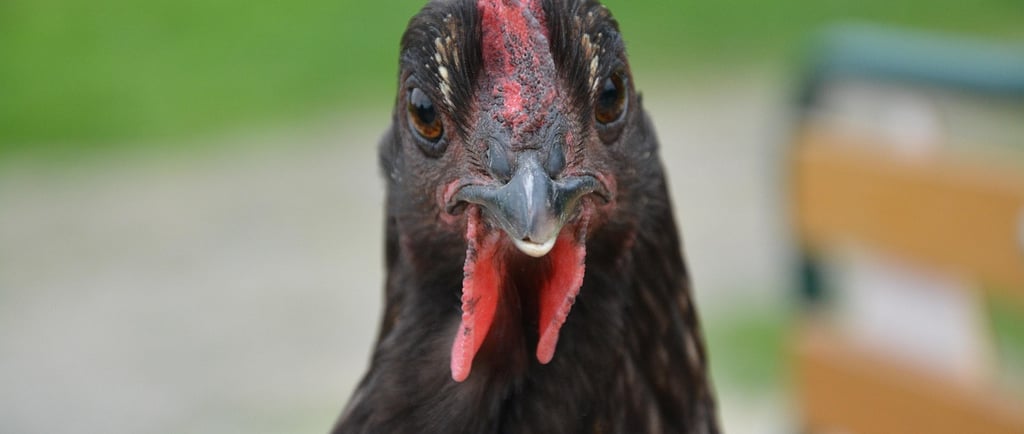
Let us look closely at the domesticated hen herself. Look at her body. Covered with feathers to keep her warm. 🪶 And when she sits on her eggs, those feathers help make a warm cover, almost like a living blanket. 🥚💛 All these body parts are clues. 🔍 They show us how this animal is adapted to live and survive.
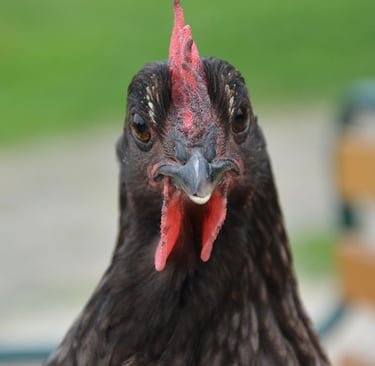
Look at her feet. 👣 They are not webbed like a duck’s feet. 🦆They are not sharp curvy claws like an eagle’s. 🦅 Do they have skin or scales? Those strong scratching feet, are made for pushing through dust, straw, leaves, and soil to find food. 🌾🍂Look at her beak. The hen does not have teeth. Just a neat, hard beak for picking up seeds, grains, little insects, and tiny bits of food. 🌱🐛 And look more closely… can you spot little openings on the beak. These are her nostrils. 👃 Now look at her eyes 👀 — do you see long eyelashes like ours? No, not really. Birds do not have eyelashes like we do, but they do have special eyelids to help protect their eyes. Which you can investigate further later.And then look on top of her head: that red floppy part is called a comb. ❤️ It is called a comb because it sticks up a little like the old combs people used for hair. And the red dangly parts under her beak are called wattles. 🎈 They аre not just for decoration, they help with keeping cool and are part of how chickens communicate.
As people kept hens near their homes, they began experimenting and breeding them. Over many generations, they bred them in different ways. Some hens became fluffy ☁️, some sleek ✨. Some grew funny crests 🎩. Some had feathered feet like a little boots🪶👣. Some had different combs — tall combs, little combs, bumpy combs. Some laid more eggs. Some were larger. Some were smaller. 🐔 And yet, through all these differences, they have the same ansestor. 🐔
People told stories about these birds too. 📖✨ In many places, the male, the rooster became a sign of morning because he crows at dawn. 🌅 It was as if he were shouting, “Wake up! The sun is coming!” ☀️🐓 In some traditions, people thought the rooster’s cry chased away darkness. In Korean tradition, the rooster has been seen as a bird of dawn and protection, and in parts of Europe the rooster became a symbol of watchfulness and the coming of light.
And think how much the hen changed human life. She changed our diet. 🍳🥧🍜🥗 We put eggs can go into sweet foods and salty foods. Cakes 🎂, breads 🍞, noodles 🍜, custards, sauces, soups 🍲 — all can carry the gifts of the hen. Her feathers could be used for pillows, quilts, decorations, and once even for pens and arrows. 🪶Her meat could feed people. 🍗 Her manure could help the soil. 🌱 One small bird… and so many gifts.
As people traveled. 🚶⛵🐪 They migrated. They traded. They sailed across waters. 🌊 And hens traveled too.From one place to another… from village to village… from land to land… the hen went with human beings. 🌍And now hens live on every continent except Antarctica. 🗺️❄️
Human beings always looked around and wondered about the animals. 🌍 Again and again, in different places, people formed relationships with animals. And the hen became one of those animals that came close to human life. 🐔🏡
And now I wonder… 🤔💭I wonder how many breeds of hens there are in the world? How many eggs a single hen lays per month? 🐔What other birds people domesticated when and where? 🦆🪿which came first as domesticated animals: goats, sheep, pigs, cattle, or hens? 🐐🐑🐖🐄🐔what animals were domesticated in different parts of the world — and why those animals? 🗺️✨
Possible Follow-Up Explorations 🚜📚
Farm visit investigation 🚜
Before visiting, the children prepare questions:
Which animals live here?
What does each animal need from human beings?
What each animal gives to human beings?
Do all animals live together or they need different encosures?
How is caring for these animals different from caring for a pet?
What jobs do people do on a farm?
After the visit, they can make a farm map, a booklet, or an oral report.
Timeline of domestication ⏳
Create a long timeline and investigate:
sheep
goats
pigs
cattle
hens
horses
The children can research approximately when each was domesticated first and place them in order. This connects beautifully to history and to the story’s final wondering.
Farm animal needs / fundamental needs work 🌾💧
Investigate what each farm animal needs:
food
water
shelter
protection
This helps children see that animals do not only give — they also need.
With Montessori joy,
Vanina 😊