🪖 Helmets On! ✨🥥 The Nut That Isn’t a Nut is Falling 🌰
🌰 A follow-up story that connects the Seed chapter to the Plant, Ecology, and Zoology chapters in the Biology Album. 🌿✨ It invites children to uncover the hidden adventure of one of nature’s most dramatic seeds — the Brazil nut — safely sealed in a woody vault that crashes to the forest floor like a green cannonball. 🪖💥 But this seed cannot sprout alone. It calls upon a team: a sharp-toothed rodent to free it 🐀, a rare bee to pollinate its flowers 🐝, and an intact rainforest to support its towering tree 🌳. This story reveals the extraordinary web of interdependence woven into seed dispersal, forest regeneration, and food cycles. It invites children to wonder: “What makes a nut a true nut, and what’s so special about this tiptoeing rodent that helps with seed distribution?” 🌱🌎💫
BIOLOGY STORIES
1/16/20263 min read
Deep in the green heart of South America, where the trees stretch tall and the parrots squawk secrets across the canopy, there stands a mighty tree — taller than most buildings and older than the oldest person on Earth! 🦜🌳🇧🇷
This is the Brazil nut tree — and when its fruit is falling you’d better put on your helmet if you happen to walk under one. 🪖😳
For thousands of years, the Indigenous peoples of the Amazon — including the Kayapó, Yanomami, and others — have gathered Brazil nuts as an essential part of their diet. 🌿🔥
These nuts were a superfood long before we used that word. They were roasted, eaten raw, or pressed into oil. The shells were used as bowls or burned for fuel. 🏕️🍲🪵 But what makes this fruit sooooo special is not how nourishing it is.
The Brazil nut tree can grow up to 50 meters high — that’s taller than a 15-story building!🏢 Or about 10 giraffes standing on top of each other! 🦒 It rises above the rest of the rainforest, its branches reaching for the clouds. And at the very top of those branches, something amazing (and a little dangerous) is growing…
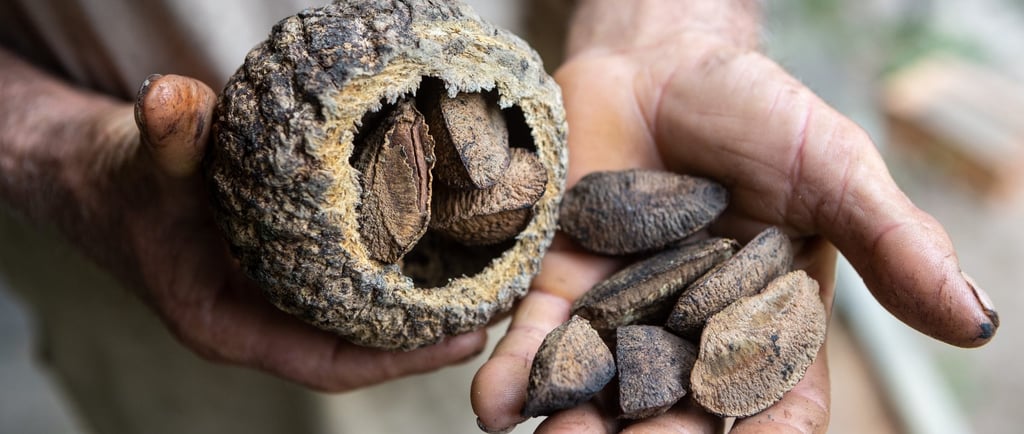
A fruit — that looks like a coconut — the size of a baseball, the weight of small watermelon, and harder than your desk. 💣+🥥 = ❗
These aren’t dainty little fruits. They are mighty cannonballs that fall from the sky.
And when they fall — they don’t just drop — they CRASH. 💥It could wake a toucan out of a nap! 🦜💤💥 Falling from more than 45 meters ( 150 feet ) up, they can reach speeds of 80 km/h (50 mph) — making them the fastest-falling fruit in the world. 🌎🥇
That’s why, during harvest season, people wear real HELMETS when walking near these trees. One direct hit, and — well, let’s just say it’s safer not to find out. 😬
When that mighty cannonball of a fruit crashes to the forest floor, something amazing lies hidden inside. To open it, you might need a saw. Or a very determined rodent.
Inside, you’ll find something that looks like a woody flower, or a natural puzzle box. Up to 24 seeds — arranged in a perfect spiral like orange wedges. 🌰🌰🌰No glue. No tape. Just pure botanical precision. Each wedge-shaped seed fits perfectly into the next, protected by a shell so strong that air and water can barely get in. That’s a Brazil nut — though it’s not a true nut.🔍 The seed is actually hidden inside yet another hard shell — a tough, woody layer for extra protection! Double protection!🛡️🛡️ Do you remember what makes something a true nut? 🤔 If you’ve forgotten, that’s a mystery worth revisiting… or maybe a story for another day. 🌰✨
But there’s one problem…
Even though these mighty cannonballs fall to the ground, they don’t open — and the seeds can’t escape on their own.They’re stuck — locked in this wooden fortress… just waiting for someone to help set them free! 🌿 So how will they ever grow into towering trees themselves?Not even monkeys 🐒, parrots 🦜, or snakes 🐍 can crack it open.
Except… one animal with teeth strong enough to chew through the rock-hard shell. It is a rainforest rodent — not very big, but very determined. She chews and chews, digs into the shell, and eats a few of the nuts. This is agouti. 🐀✨.
She doesn’t eat them all. She buries some — to save for later. (Which she forgets. A lot.)🫣 And that’s how new Brazil nut trees grow! Because without the agouti, no tree could ever spread its seeds. 🌱
But the Brazil nut tree needs more than just the agouti. It needs… 🐝 A special orchid bee that can open its complex flowers and pollinate them. 🌳And people who respect the forest, gathering the fruits without cutting the trees.🙋♀️
So one delicious Brazil nut is the result of a whole web of rainforest helpers — a giant tree, a brave bee, a forgetful rodent.🌎✨
I wonder .... Which other animals have found a way to open the Brazil nut and reach the precious nutritional seeds? Can Brazil nut trees grow well outside the rainforest? Which other nuts are not true nuts but are still called nuts?
✏️ Possible Follow-up Explorations:
🌱 Biology & Botany & Art
🖍️ Create a botanical drawing of the Brazil nut’s journey: from flower to fruit, to seed, to tree.
🦷 Find more about agouti , and compare the teeth with other rodents. What makes her special?
🌰 What is a true nut, and what makes the Brazil nut different? Make a chart comparing true nuts (like chestnuts and hazelnuts) with “nut imposters” like Brazil nuts, almonds, and cashews.
🧪 Try cracking different seed coats and rank them by toughness (don't forget safety goggles!).
🌍 Human Geography & Trade
🗺️🌐 Make a trade map: 🔍 Find out who are the largest producers and consumers of Brazil nuts today.
📦 What is an extractive reserve? How does Brazil nut harvesting help preserve the rainforest?
With Montessori joy,
Vanina 😊